

2026-09-01 · Mountain Biking
A practical introduction to Atlas mountain biking terrain, handling, fitness and choosing between day and multi-day riding.
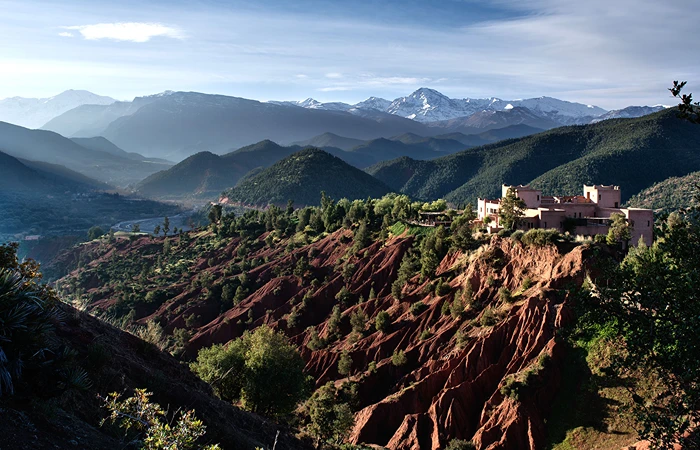
Mountain biking in the Atlas Mountains is shaped by contrast. Routes can connect cultivated valleys, mountain villages, climbing tracks, passes and descents over surfaces that change with weather and use. The riding experience is therefore defined by more than distance. Gradient, traction, exposure, altitude, time on the bike and confidence on uneven ground all influence how a day feels.
Isouktan currently publishes a full-day Atlas ride and a three-day mountain-bike programme. This guide explains how to compare those formats and what to examine before choosing. It does not promise a particular bicycle, guide qualification, support vehicle, transfer or trail condition. Those operational details must come from the selected product and final arrangements.
The Atlas is not one type of trail
“Atlas Mountains MTB” can suggest a single signature surface, but mountain routes rarely remain uniform. A day may combine smoother approach sections, compacted tracks, rougher stones, loose corners, steeper climbs and village connections. Rain, dry periods, maintenance and local traffic can alter a surface after an itinerary is written.
Read route statistics where the source provides them, but do not use distance alone as a difficulty measure. A shorter ride with sustained climbing or technical descending can demand more concentration than a longer smooth route. Elevation gain, surface, gradient and recovery time belong beside kilometres.
What handling questions should you ask?
- Are you comfortable braking and choosing a line on loose or rocky ground?
- Can you remain balanced while climbing slowly on an uneven surface?
- How do you respond to narrow sections, changing traction or sharper corners?
- Can you descend under control without following another rider’s speed?
- Have you ridden for several hours while maintaining concentration?
A full-day ride: focused and easier to fit into a trip
The Full-Day Atlas Mountains Bike Tour presents the most compact MTB format in the catalogue. Its source contains detailed route statistics, difficulty, pricing, availability, inclusions and exclusions. Those fields should be read directly rather than replaced by a generic description of biking near Marrakech.
A day trip removes the repeated recovery of a multi-day journey, but it still deserves preparation. Riders meet the day’s complete climbing, descending and handling demands in one outing. It can suit someone adding active travel to a wider Morocco visit, or someone who wants to assess Atlas riding without committing to several consecutive days.
Do not infer overnight accommodation or multi-day luggage arrangements: they do not belong to a full-day product. Likewise, proximity to Marrakech should not be converted into an unverified promise about pickup, transfer time or meeting point. Check the itinerary and confirmed arrangements.
Three days: route progression and accumulated effort
The Atlas Mountains MTB Tour – 3 Days moves beyond a single outing. Its itinerary uses the Imlil, Tizi n’Tamatert and Imnane area over three days. Part of that geography overlaps the day ride, but the products are separate because their duration and route progression differ.
Multi-day riding adds questions that do not appear fully on day one: how you recover after climbing, how hands and contact points feel the next morning, whether concentration remains strong, and how clothing dries or layers are managed. A rider can have enough fitness for one ambitious outing while lacking experience with three consecutive days.
What changes after the first day?
- Small bike-fit discomfort can become more noticeable.
- Hands, shoulders and legs must recover for another start.
- Nutrition and hydration choices affect the next stage.
- Repeated descents ask for sustained attention, not only strength.
- Clothing and personal kit must work across changing days.
Fitness and bike handling are separate
Strong road fitness can help on climbs without automatically preparing someone for loose surfaces. Technical confidence can make descending efficient without replacing endurance. Assess both sides honestly. Training should include steady aerobic riding, climbing where available and deliberate practice of braking, cornering, body position and controlled low-speed movement.
Use recent experience rather than a ride completed years ago. If most of your riding happens on smooth roads or indoor equipment, introduce varied surfaces progressively. Avoid making the first technical session the first day of the trip.
Comfort and bike fit across an Atlas ride
Bike fit affects control as well as comfort. A position that feels acceptable for a short spin can create hand, shoulder, knee or saddle discomfort over several hours. Before travelling, spend time in the clothing and footwear you expect to use and notice whether you can move freely around the bike rather than remaining fixed in one position.
Personal setup questions depend on whether you bring a bike or use equipment arranged separately. This article does not promise either option. In both cases, confirm sizing and compatibility early enough to solve problems before the first climb. If you use unfamiliar equipment, allow time to understand braking, shifting and contact points.
Prepare contact points, not only your legs
- Build saddle time gradually across several weeks.
- Check that gloves and grips do not create pressure or numbness.
- Use shoes you can control the bike in and walk in where necessary.
- Practice carrying and retrieving water without losing balance.
- Address recurring discomfort rather than expecting it to disappear on tour.
Weather and terrain remain variable
Atlas conditions can influence grip, visibility, heat exposure and route decisions. Dry loose ground behaves differently from wet stone or compact track. Strong sun increases hydration and protection needs; cooler or windy mountain sections may require an accessible layer. No article can guarantee what a trail will look like on a future date.
Condition-led changes should not be treated as a failure to deliver a fixed line. A published itinerary explains the intended journey, while current access, weather and group ability may require decisions. Ask how route changes are communicated without assuming a support setup that is not stated.
Marrakech as a gateway—not a universal promise
Both published Atlas MTB products are presented in relation to Marrakech, which makes the city relevant to planning. That does not mean every cycling product has identical transport or meeting arrangements. The eight-day e-bike route and ten-day gravel journey use different geographic progressions and should be read separately.
Check the first and last itinerary entries for meeting, transfer and return information. If your accommodation or onward travel depends on timing, ask for confirmation rather than relying on a broad phrase such as “from Marrakech.”
MTB, gravel and e-bike are not interchangeable labels
The current Mountain Biking collection contains mountain-bike, e-bike and gravel products. MTB generally places greater emphasis on handling uneven tracks and descents. Gravel journeys often involve longer mixed-surface stages and a different riding position. Electric assistance can change how effort is distributed, but it does not remove distance, handling, weather or time in the saddle.
Choose by the route rather than by which label sounds easiest. The Morocco E-Bike Tour has no formal source-supported difficulty rating, so it should not automatically be classified below the MTB products. The gravel tour’s ambiguous `1200` source value was intentionally not imported as a price and should not reappear in planning content.
Personal preparation and equipment questions
Comfortable activity clothing, sun protection, hydration capacity and layers appropriate to changing mountain conditions are general planning needs. Cycling-specific choices can include gloves, eye protection, suitable footwear and personal items that you know fit. The equipment guide provides a broader checklist.
Do not assume a bike, helmet, repair kit, mechanic or vehicle is included merely because it is commonly discussed in cycling travel. Review the selected trip’s included and excluded sections and confirm anything unclear. If bringing personal equipment, verify transport and compatibility arrangements before departure.
Pacing a mountain-bike day
A fast opening climb can make later technical sections harder by reducing concentration. Use an effort that leaves enough control for the whole route, eat and drink before fatigue becomes obvious, and communicate if the surface demands more attention than expected. Descending is not passive recovery: hands, vision and decision-making continue to work.
On a multi-day route, today’s pacing also protects tomorrow. Finishing every climb at maximum effort may be satisfying on a single training ride but can undermine recovery across three stages. The itinerary provides the sequence; your preparation should provide the restraint to ride it consistently.
How to choose between the Atlas day and three-day rides
| Question | Day ride | Three-day ride |
|---|---|---|
| Time commitment | One focused active day | Three-day route progression |
| Recovery | No second riding morning | Repeated riding and recovery |
| Decision focus | Can I manage the stated day? | Can I repeat comparable effort? |
| Planning | No overnight MTB assumption | Read each overnight and daily stage |
Use this comparison as a prompt, then return to the source-derived route statistics, itinerary, price and inclusions. When you have checked recent fitness and handling experience, the booking guide explains how to submit a request and ask about unresolved practical details.
Tags: High Atlas
