

2026-09-01 · Hiking & Trekking
Compare warmer, shoulder-season and winter Mount Toubkal conditions, and understand how timing changes preparation and route choice.
The best time to climb Mount Toubkal is not one fixed month that suits every traveller. Timing changes the surface underfoot, the clothing and equipment questions, the amount of daylight, the likely temperature range and the type of itinerary that makes sense. It also changes what experience you should bring to the mountain.
A useful decision therefore begins with the experience you want. Are you looking for a compact warmer-season ascent, a deliberately winter-focused journey, or a longer circuit that includes Lake Ifni and more of the surrounding massif? Those are separate products in the Isouktan catalogue, and season should help you choose between them rather than being treated as a small detail added after booking.
Mount Toubkal changes markedly through the year
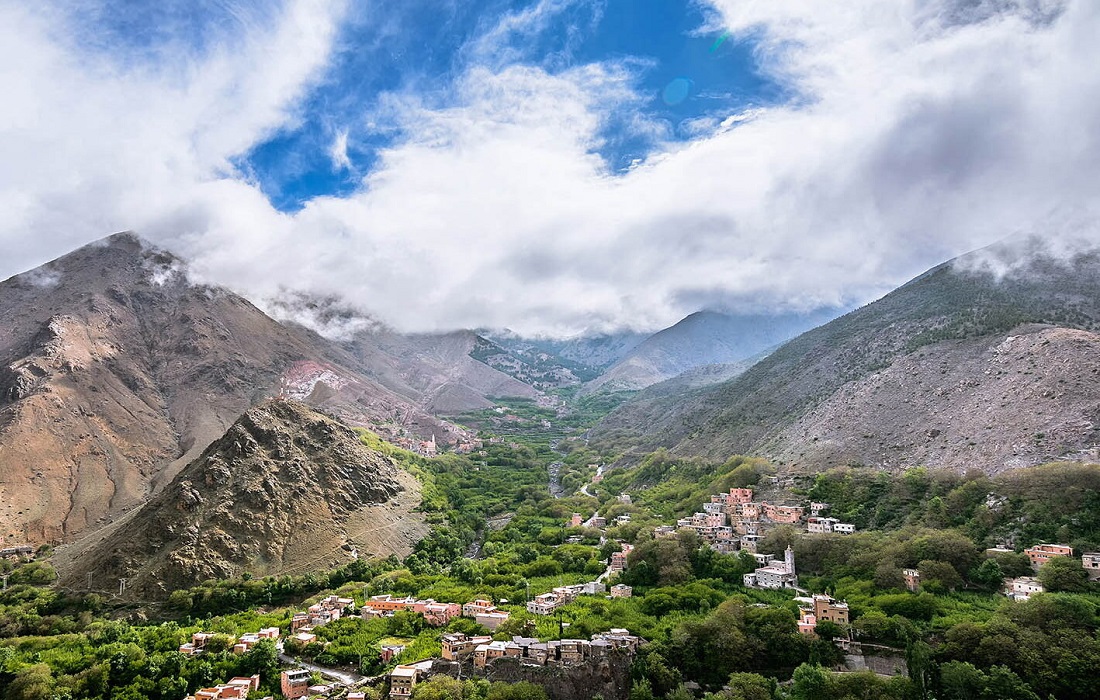
Mount Toubkal rises above valleys that can feel much warmer and more settled than its upper slopes. Conditions in Marrakech or Imlil do not describe the summit. Elevation, exposure, wind and cloud can create a sharp contrast over the course of one route. Even within a broad season, one week may differ from the next.
This is why a calendar can offer context but cannot guarantee a surface condition. Recent snowfall, freeze-thaw cycles, wind and daily temperature changes affect what walkers encounter. Check current mountain information near departure and keep the final plan responsive to conditions.
Warmer-season Mount Toubkal
During the warmer part of the year, travellers generally choose Mount Toubkal for a walking ascent rather than a specifically winter mountaineering experience. Lower paths may be dry and warm while the upper mountain remains cooler and exposed. Sun protection, hydration, pacing and an early start can become as important as insulation.
The two-day Mount Toubkal trek is the catalogue’s compact route. It suits travellers comparing a short summit-focused itinerary, but the word “summer” should not be confused with an effortless or uniform trail. The programme still concentrates ascent, summit effort and descent into two days. Read the structured itinerary and assess the longest stage.
What warmer conditions change
- More attention may be needed for sun exposure and carrying water.
- Temperature can vary substantially between valleys, refuge areas and high ground.
- Afternoon heat can make pacing and start time important.
- A dry-looking forecast does not remove the need for wind and weather protection.
- Busy periods can change the atmosphere without changing the physical route.
No exact temperature promise belongs in an evergreen article. Forecasts and mountain conditions should be checked for the actual dates, using reliable current sources.
Shoulder-season considerations
Spring and autumn are often discussed as single blocks, but they are transitions. Snow can linger late on high ground or arrive earlier than expected. Lower valleys may show signs of a new season while the summit area retains the previous one. Daylight, overnight temperature and trail surface can all shift during these periods.
The practical consequence is uncertainty, not necessarily unsuitability. Travellers should be ready to confirm whether the route is functioning as a normal walking ascent or whether winter skills and equipment questions apply. Packing for a date rather than a condition can leave important gaps.
Questions to ask before confirming shoulder-season dates
- What are the current upper-mountain surface conditions?
- Is snow or ice equipment expected for the planned route?
- How much daylight is available for the longest day?
- Does the proposed itinerary allow a realistic pace for the group?
- Which layers must remain accessible during rapid weather changes?
Winter is a different mountain journey
Winter Mount Toubkal should not be described as the ordinary trek with a heavier jacket. Snow and ice can cover the route, navigation can become less obvious, wind chill can increase exposure, and shorter daylight changes timing. Winter travel also introduces technical equipment and skills that may not be relevant on a dry trail.
The five-day Winter Mount Toubkal Trek is designed around that seasonal context. Its extra days do not guarantee a summit or safe conditions. They form a different programme whose objectives remain subject to weather, snow, mountain conditions and group ability.
Snow is not guaranteed simply because a booking falls within a calendar winter, and a particular depth or surface should never be promised in advance. Equally, a period with limited snow should not be interpreted as removing all winter hazards. Final decisions need current observation and appropriate judgement.
How season changes clothing and equipment
Across seasons, a flexible layering system is more useful than relying on one bulky garment. A base layer manages moisture, an insulating layer retains warmth, and outer layers protect against wind and precipitation. Sun protection remains relevant at altitude even when air temperatures are low.
Footwear must suit the expected surface and any technical equipment. Gloves, warm headwear and spare protection may move from optional comfort to essential winter planning. Water systems also behave differently in cold conditions. The full clothing and equipment guide separates general personal items from route-dependent technical kit.
Do not infer that Isouktan provides or rents an item unless the selected trip explicitly confirms it. Ask for the final equipment list after dates and conditions are considered.
Daylight, temperature and pacing
Longer daylight can provide more margin, but it should not encourage an unnecessarily late start on a demanding day. Short winter days make timing more visible, while heat in warmer periods can also favour early movement. The group’s real pace, breaks, surface and descent all matter more than a generic walking-time estimate.
Temperature affects more than comfort. It changes clothing adjustments, water consumption, rest-stop length and how quickly hands can manage equipment. Wind can make a moderate air temperature feel much more severe on exposed ground. Carry layers where they can be reached without unpacking the entire bag.
Accommodation and crowds are planning factors, not seasonal guarantees
Some periods can attract more walkers, but crowd levels vary by weekday, holidays, weather and local circumstances. Avoid presenting any month as reliably empty or busy. If atmosphere matters, ask about the expected situation for your dates and recognise that a popular route remains a shared mountain space.
Season also affects how overnight stops feel. Cold changes sleeping comfort and the usefulness of spare layers; warmer days increase the importance of changing out of damp clothing and managing hydration. Use the accommodation named in the itinerary rather than assuming a hotel, refuge or private-room standard from the season.
Common timing mistakes
- Choosing dates from valley temperatures rather than mountain conditions.
- Assuming a warmer month removes wind or cold from high ground.
- Buying winter equipment without learning how and when it is used.
- Treating historical snow photographs as a forecast.
- Allowing a fixed summit expectation to override current conditions.
- Using one seasonal range for every route in the Toubkal Massif.
Avoiding these mistakes does not require predicting the mountain months in advance. It requires choosing the right type of itinerary, preparing for plausible variation and confirming current information when it becomes relevant.
Choosing between the three Toubkal itineraries
If your priority is a compact summit-focused route in non-winter conditions, compare the two-day itinerary with your fitness and available time. If the winter environment is the reason for travelling, read the five-day winter programme and its equipment guidance. If you want a longer journey through the massif, the Mount Toubkal and Lake Ifni circuit adds a different route shape and seven-day commitment.
The Lake Ifni source contains conflicting wording about its exact seasonal start. This article does not settle that conflict by choosing one date. Confirm the intended operating window for your proposed departure.
Fitness and experience still matter in good weather
A stable forecast does not reduce the mountain’s altitude or the amount of ascent and descent. Prepare through regular walking, hills and time on varied ground. Test footwear, learn how your daypack feels after several hours and consider how you recover after a demanding outing.
Winter adds a separate experience question. Owning equipment is not the same as having the skills to use it. Be honest about previous movement on snow and ice, comfort in cold conditions and ability to follow condition-led decisions. Unsupported claims about guide certifications or guaranteed safety do not replace personal preparation.
A better way to choose your dates
- Decide whether you want a walking ascent, winter objective or longer circuit.
- Read the actual itinerary and identify its longest day.
- Compare your recent experience with the expected terrain and season.
- Prepare clothing and footwear for elevation, not only the gateway city.
- Confirm current conditions and technical equipment close to departure.
- Keep summit expectations flexible when weather or mountain conditions change.
Browse the full Morocco hiking and trekking collection to compare Toubkal with longer M’Goun, southern mountain and Sahara itineraries. When you have dates in mind, use the booking-request guide to send the details that need confirmation.
Tags: Mount Toubkal, High Atlas
